
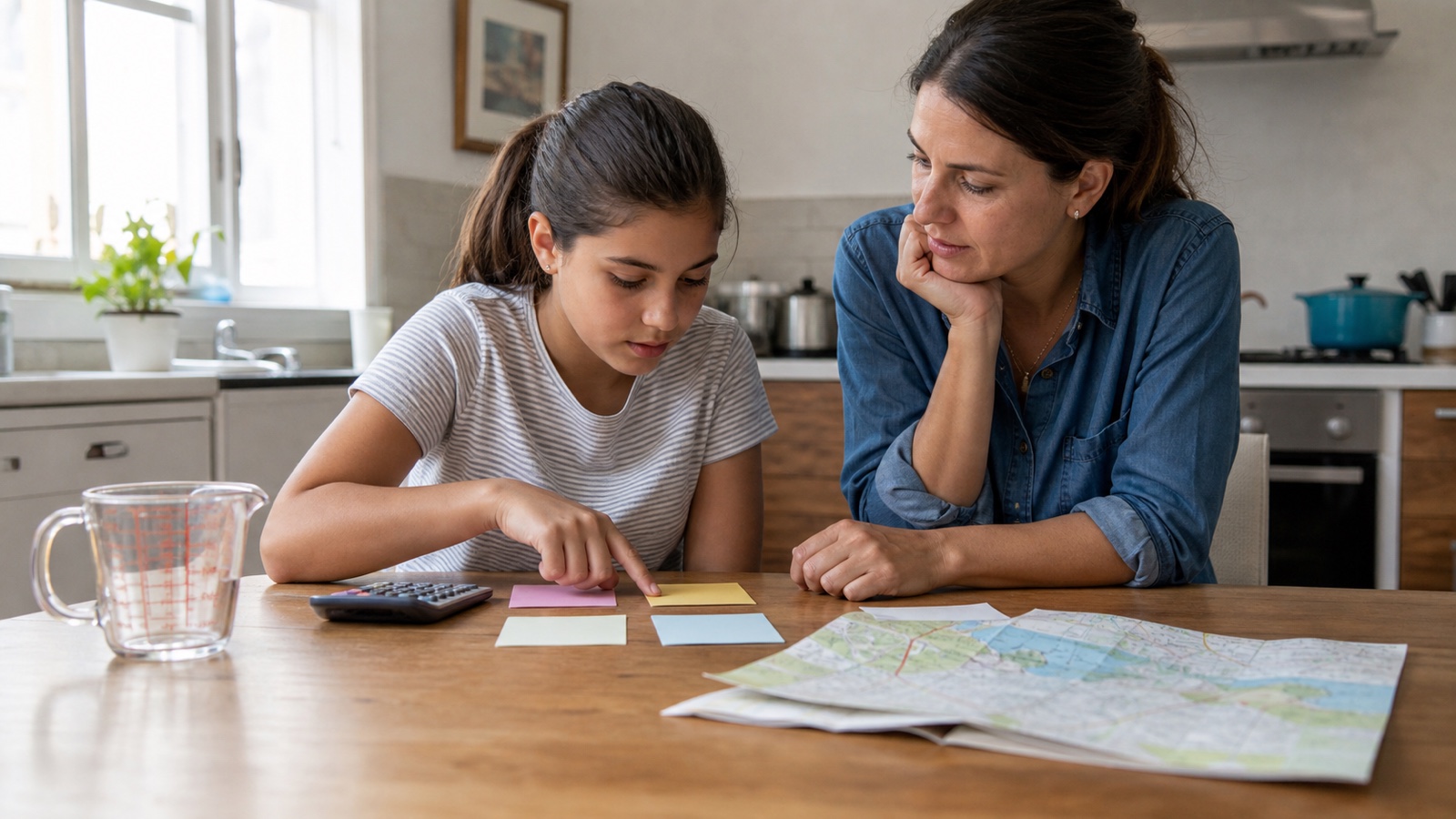
Life skills education teaches practical abilities for daily life. It is not one fixed curriculum. It is a set of practices that homes and schools can weave into daily routines. This article uses a World Health Organization handbook as one organizing framework. That handbook groups life skills around decision-making, problem-solving, critical and creative thinking, communication, interpersonal relationships, self-awareness, empathy, and coping with stress and emotions. The handbook offers guidance for health teaching. It does not prove that one universal curriculum fits every age, culture, or setting. (World Health Organization, 2020)
This guide explains what life skills education means and what it includes. It shows how to teach it at home and in the classroom. It treats school and home learning as partners, never as rivals. It also shows how to plan age-fit practice that respects each child's context, abilities, and safety.
What counts as a life skill and what does not
A life skill is a practical ability for daily life. It helps a child weigh a choice, settle a conflict, or calm a racing mind. The WHO framework offers a clear guide to the main groups. It is a planning tool for health education, not a fixed checklist for every child. (World Health Organization, 2020) The core groups are:
- Decision-making and problem-solving
- Critical and creative thinking
- Communication and interpersonal relationships
- Self-awareness and empathy
- Coping with stress and emotions
Knowing what a life skill is not makes teaching clearer. Chores build responsibility, but a life skill is the deeper ability beneath the chore. Planning a sequence of tasks is one example. Vocational skills prepare a child for a specific job. Life skills serve many roles across a lifetime. Labels such as character or morality carry cultural and religious meaning. Life skills education focuses on clear, teachable abilities instead. It is also not therapy or clinical care. A parent or teacher can coach a child through a hard moment. Yet persistent distress, developmental concerns, or safety risks call for qualified support.
What does the research actually show
A large meta-analysis of universal school-based social and emotional learning programs pooled 424 studies from 53 countries. It covered 252 programs and 575,361 students. On average, those in programs fared better than peers on skill, attitude, conduct, and school measures. Yet results varied with content, setting, program features, and how well staff carried out the work. (Cipriano et al., 2023) In short, sound programs often help, but the details of how and where matter a great deal.
For money skills, the pattern echoes that finding. Across 37 school trials, effects were larger for knowledge than for action. In the 18 randomized studies, average gains reached about 0.15 standard deviations for knowledge and 0.07 for conduct. No single lesson or plan secures later financial safety. (Kaiser & Menkhoff, 2020)
Research on self-control also calls for a careful reading. A New Zealand study tracked about 1,000 people to age 32. Childhood self-control predicted later health, money, substance trouble, and offending, even after adjusting for IQ and social class. The design shows prediction, not proof that self-control alone causes a given result. (Moffitt et al., 2011) No single skill decides a person's future.
How to teach life skills with age-fit practice
A simple teaching cycle can guide a parent or educator. The steps are model, practice, feedback, reflection, repetition, and transfer. This cycle blends common methods into a practical synthesis. It is not a proven universal formula. First, you show the skill. Next, the child tries it in a low-stakes spot. Then you give kind feedback and invite reflection. You repeat the steps over time. Finally, you help the child use the skill in a new setting.
The table below offers a planning frame. Each row lists a domain, an optional age-fit scenario, the practice, a visible act, a debrief question, and a safety note.
| Domain | Age-fit scenario | Practice | Observable behavior | Debrief question | Adaptation or safety note |
|---|---|---|---|---|---|
| Decision-making | A 9-year-old picks between two after-school clubs | List pros and cons together, then let the child choose | Child can state reasons for the choice | "What made you pick this one?" | Keep choices within family values and budget |
| Problem-solving | A 12-year-old faces a group project clash | Use a step-by-step method: name the issue, list ideas, try one | Child can name the problem and offer at least two ideas | "What could you try differently next time?" | Step in if the clash turns hostile or unsafe |
| Communication and conflict | Two siblings argue over a shared device | Practice an "I feel, I need" sentence before the real talk | Child can try the sentence instead of shouting or blaming | "How did it feel to be heard?" | Coach, do not referee; pause if feelings run too high |
| Coping and emotion | A 7-year-old feels swamped before a school show | Try slow breathing or a short sensory break together | Child can try the routine with a gentle reminder | "What helped your body calm down?" | If distress is frequent or intense, seek a professional view |
| Applied money practice | A 14-year-old gets a monthly sum | Split it into a simple plan with a monthly review | Child can track amounts and adjust the plan | "What did this month teach you?" | Keep amounts small and kind; review the plan together |
| Practical independence | A 16-year-old plans meals for the week | With guidance, write a list, shop, and cook one meal | Child can finish the task from plan to table | "What part felt hardest?" | Adapt for food needs, skills, and family routines |
| Digital and source checking | A 15-year-old sees a viral claim online | Use a check rule: find the source, check two outlets, pause before sharing | Child can explain why a claim may or may not be true | "What would make you more sure?" | Talk about privacy, scams, and when to ask an adult |
Where home and school learning fit together
Homes and schools can offer practice in parts of the same skills. A classroom can provide a stage for group problem-solving. A teacher can watch many students at once. A home can offer repeated practice with money plans and daily routines. The cited meta-analysis found varied results across school programs, with outcomes shifting with content, setting, features, and implementation. (Cipriano et al., 2023) Home practice is a possible complement to what a child learns in school.
Parents can support what teachers introduce with one simple question: "What did you try, and what happened?" Educators can name the skills practiced in class to invite parents in. Neither side needs to replace the other. Both can offer steady, low-stakes chances to practice.
How to adapt life skills education to the child
Every child brings a distinct culture, language, temperament, and strengths. Bend the teaching to fit the child, not the other way. In multilingual homes, practice the skill in the child's strongest thinking language. For a child with a disability or neurodevelopmental difference, break the skill into small steps and give more time. For a child who has known trauma, move slowly, lower pressure, and build felt safety before any lesson. Families with tight resources can teach a skill like weekly planning with paper and talk alone.
Know when to hand the work to a professional. Seek qualified help if a child shows signs of clinical distress, a learning or developmental block that disrupts daily life, or any risk of abuse or self-harm. A general article cannot replace individual assessment. Reach out to an educational, medical, mental-health, or safeguarding professional. Life skills education supports healthy growth; it does not treat illness or mend harm.
Key takeaways
- This article organizes practice around decision-making, problem-solving, thinking, talk, self-awareness, empathy, and coping in age-fit ways.
- The WHO handbook gives a helpful frame, not a fixed course. (World Health Organization, 2020)
- School programs help on average, but results shift with content, setting, and how well staff carry them out. (Cipriano et al., 2023)
- Financial lessons lift knowledge more than action. Self-control findings show prediction, not a fixed destiny. (Kaiser & Menkhoff, 2020) (Moffitt et al., 2011)
- Homes and schools can offer complementary practice, though the cited evidence does not compare which partnership model is best.
- Adapt every lesson to the child's age, culture, language, traits, and safety needs.
Frequently asked questions
References
- Cipriano, C., Strambler, M. J., Naples, L. H., Ha, C., Kirk, M., Wood, M., ... & Durlak, J. (2023). The state of evidence for social and emotional learning: A contemporary meta-analysis of universal school-based SEL interventions. Child Development, 94(5), 1181-1204.
- Kaiser, T., & Menkhoff, L. (2020). Financial education in schools: A meta-analysis of experimental studies. Economics of Education Review, 78, 101930.
- Moffitt, T. E., Arseneault, L., Belsky, D., Dickson, N., Hancox, R. J., Harrington, H., ... & Caspi, A. (2011). A gradient of childhood self-control predicts health, wealth, and public safety. PNAS, 108(7), 2693-2698.
- World Health Organization. (2020). Life skills education school handbook: Prevention of noncommunicable diseases. World Health Organization.
This article is for informational and educational purposes only and does not constitute financial, legal, tax, medical, or professional advice. Individual results vary.