
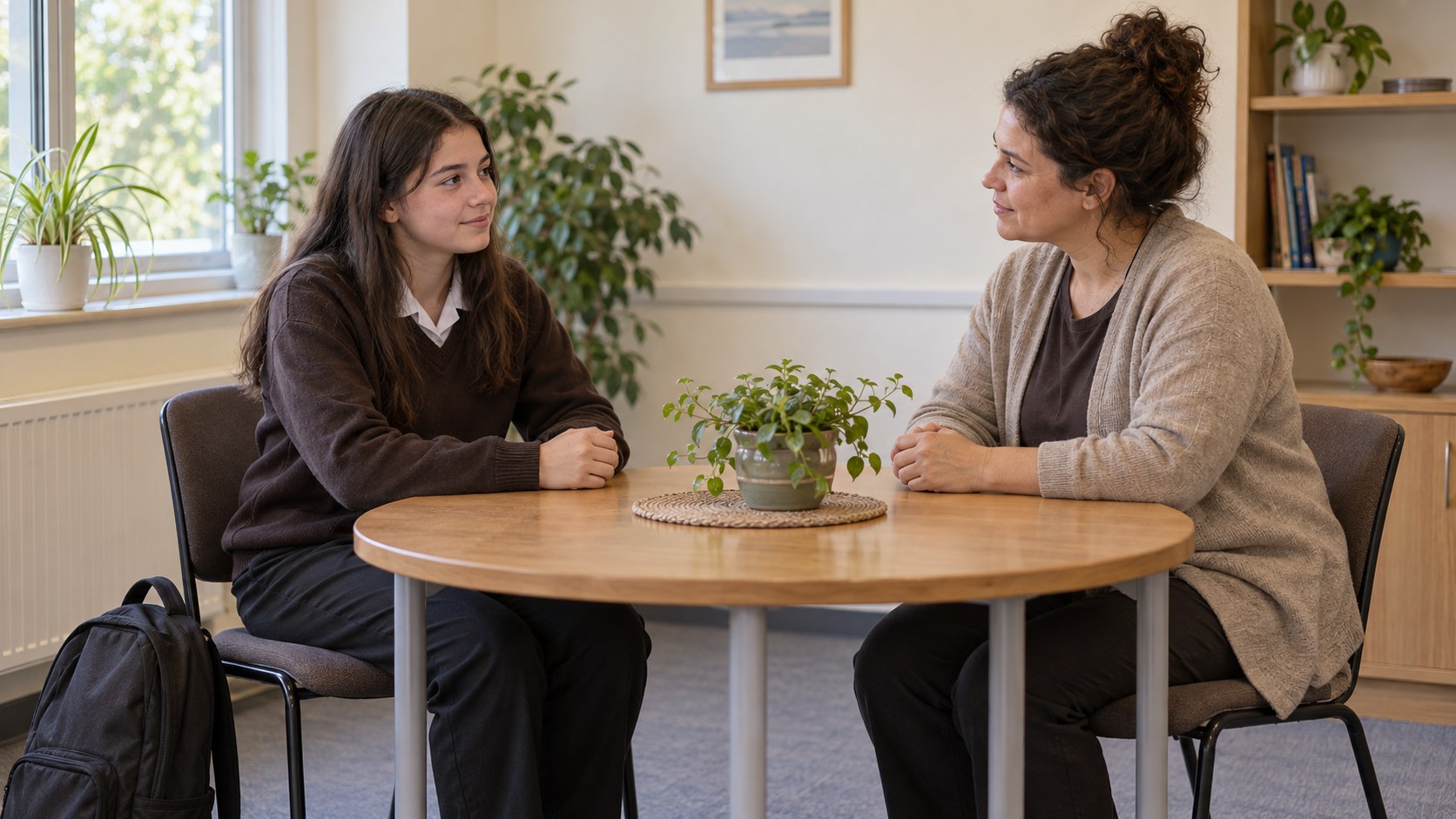
Young carers and mental health raise a practical question: is the care a young person gives seen, shared and supported by adults? Caring can carry meaning and closeness. It can also carry strain.
Who counts as a young carer?
A young carer is someone under 18 who helps care for a family member who is ill, disabled, or misusing substances. The care goes beyond ordinary chores. It can include practical, emotional or personal support (NHS, 2024a).
Ordinary chores, such as tidying a room or feeding a pet, do not make a child a young carer. Some research also includes young adults up to age 25 (Fleitas Alfonzo et al., 2022). In England, a council can assess what support a young carer and the family need (NHS, 2024a). Other countries have their own rules.
What does research say about young carers and mental health?
Research suggests a link between caring and poorer mental health, but the picture is mixed. A 2022 review of ten studies found that nine linked young caring with worse mental health. Only three followed people over time. The quality of the evidence was low, so cause cannot be assumed (Fleitas Alfonzo et al., 2022).
Tracking young carers across years can help clarify what comes before what (Fleitas Alfonzo et al., 2022). But time order alone cannot prove that caring causes poor mental health. Other family circumstances may also play a part.
A newer review of 17 studies that followed people over time found results that were mostly adverse but small to moderate. They varied between groups. How heavy the care was, how long it lasted, what tasks were involved, and the social setting all mattered. Because these were observational studies, other explanations cannot be ruled out (Bowman Grangel et al., 2025). Caring alone is not proved to cause distress.
Physical health results in the newer review were limited: just six of seventeen studies looked at physical health, and the authors drew few firm conclusions (Bowman Grangel et al., 2025). We should not assume mental-health findings apply to every physical condition or every young carer.
Does helping at home always harm a child?
No. Helping can give a sense of purpose and closeness. Strain often grows when duties are heavy, hidden, or unsupported. A realist synthesis of 44 studies described caring, identity, and support as parts that interact. That helps explain why outcomes differ so much (Janes et al., 2022).
Caring can matter deeply to a child, yet the duties still need adults to help. Pride is not proof the load is safe, and distress is not proof the child does not care. Listening to young carers and holding adult responsibility can go together.
One way to work through it is a short conversation aid. Cover four points: what tasks the young person does, how school and rest are affected, which backup adults exist, and what the young person wants. Use this aid alongside safety planning and professional assessment. It does not replace them.
When does the care load need a closer look?
An Australian prospective cohort followed young carers from ages 16-17. Researchers grouped caring tasks into two types. Core tasks meant personal care, mobility and communication support. Non-core tasks included household chores and some health-care tasks. Two years later, the study tracked a combined outcome: self-harm or suicide attempt. Core caring was associated with a higher combined outcome, (King et al., 2026). The thoughts-only result was not statistically conclusive. No clear non-core association appeared, but that is not proof of no risk. Non-core tasks are not necessarily easier or fewer in hours.
The study used full data from 2,089 young people. Gaps in records can limit what it tells us. This was a group-level finding. It cannot prove that caring caused these outcomes. It cannot tell you what any single child faces.
How can adults ask about caring without blaming families?
Start with a respectful check-in, not an accusation. Ask what the young person does day to day, what they enjoy, what feels hard, and what they wish adults knew. Listening to the child is one important part of an assessment. It sits alongside safety, education, rest, and appropriate adult responsibility.
Privacy has limits. If a worker believes a child is at risk, they may need to share information to keep the child safe. Explain that honestly and gently. A check-in can open the door to a formal assessment. The two work together rather than as competing options.
Possible routes include trusted school staff, a family doctor or nurse, a social worker, or a young-carer service (NHS, 2024b). Keep ordinary help, clinical care, and urgent safety distinct. If danger feels immediate, contact emergency services.
What support can a young carer ask for?
A young person can ask for practical help, a break, school adjustments, or someone to talk to. They can also ask that care tasks be reviewed, with safety, education, rest, and age-appropriate responsibility in view. Wanting to help and needing support can go together (NHS, 2024a).
Adults should lead any safe care plan, especially where medicines, moving, or personal care are involved. Adults should arrange suitable trained help for clinical care. For related ideas on growing independence, see age-appropriate autonomy and support.
Key takeaways
- Research links heavy caring with poorer mental health, but cause is not proved.
- Core personal, mobility, or communication care deserves closer adult attention.
- A respectful check-in can lead to a formal assessment and shared support.
- The child's wishes matter alongside safety and appropriate adult responsibility.
Frequently asked questions
References
- Bowman Grangel, A., McMahon, J., Dunne, N., O'Donoghue, F., & Gallagher, S. (2025). Health outcomes and psychosocial determinants in young carers: A systematic review. The Lancet Public Health, 10(7), e625-e639. doi:10.1016/S2468-2667(25)00099-4
- Fleitas Alfonzo, L., Singh, A., Disney, G., Ervin, J., & King, T. (2022). Mental health of young informal carers: A systematic review. Social Psychiatry and Psychiatric Epidemiology, 57(12), 2345-2358. doi:10.1007/s00127-022-02333-8
- Janes, E., Forrester, D., Reed, H., & Melendez-Torres, G. J. (2022). Young carers, mental health and psychosocial wellbeing: A realist synthesis. Child: Care, Health and Development, 48(2), 190-202. doi:10.1111/cch.12924
- King, T., Redmond, G., Reavley, N., Hamilton, M., & Barr, A. (2026). A prospective study of suicide and self-harm among young carers using an Australian cohort. Australian & New Zealand Journal of Psychiatry, 60(2), 160-170. doi:10.1177/00048674251391993
- NHS. (2024a, March 27). Being a young carer: Your rights. NHS social care and support guide.
- NHS. (2024b, February 26). Help for young carers. NHS social care and support guide.
This article is for informational and educational purposes only and does not constitute financial, legal, tax, medical, or professional advice. Individual results vary.